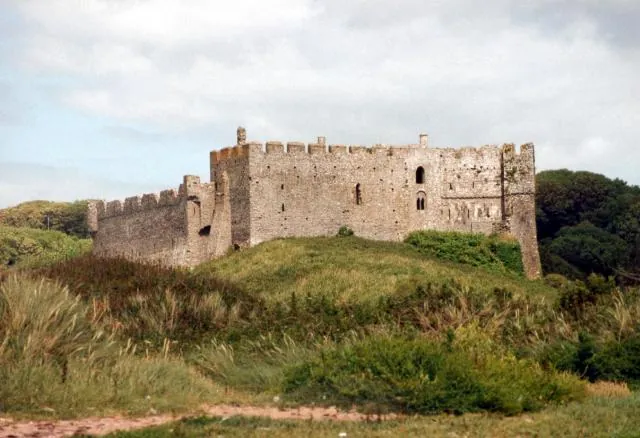
Manorbier Castle sits in a valley above a beach, eight kilometres south-west of Tenby, and it has the best setting of any castle in Pembrokeshire.
Castell Maenorbŷr was founded in the late eleventh century by the de Barry family, Anglo-Normans holding it as a mesne lordship under the Earls of Pembroke, and it remains privately owned today.
Gerald of Wales — Giraldus Cambrensis — was born here in about 1146, grandson of the Norman Gerald of Windsor and the Welsh princess Nest ferch Rhys.
He became one of the most readable writers of the Middle Ages: archdeacon, four times an unsuccessful candidate for the see of St Davids, and author of the Itinerarium Cambriae and Descriptio Cambriae, written after he travelled Wales preaching the Third Crusade and recorded what he saw with a sharp and self-regarding eye.
Of his birthplace he wrote that it was the pleasantest spot in Wales, describing the fishpond, the orchard, the mill and the hazel wood beneath the walls. Remarkably, the arrangement he described is still legible on the ground.
Not large. A curtain wall with towers, a gatehouse, a barrel-vaulted chapel, a great hall and residential ranges — the house of a lord rather than a great fortress, which is exactly what the lordship required.
It was never seriously besieged and declined quietly, which is why so much of the domestic arrangement survives. The chapel is the best of the interiors.
Inside there are waxwork tableaux in some chambers and displays on Gerald and the de Barrys.
The view from the walls, down the valley over the beach and out to the Channel, is the strongest thing about it.
It is a small castle, and it does not pretend otherwise. The admission price reflects that, and most visitors judge it decent value on those terms — particularly compared with the large Welsh castles.
Staff attract mixed comment, with more than one visitor reporting an unwelcoming reception. That is a private-ownership variable rather than a policy, but it comes up often enough to mention.
Weddings and private events take place in the grounds and can affect access, so check if you are making a special journey.
The sensible plan: an hour to ninety minutes, combined with the beach, the church and a walk on the coast path — as part of a day rather than as a destination.
Specific and useful: park at the beach car park, then turn right and cross the road into the secret garden to reach the entrance. Parking elsewhere is very limited.
Manorbier Beach, sandy and south-facing below the castle, with rock pools and reliable surf.
St James’s Church, twelfth-century, across the valley.
King’s Quoit, a Neolithic burial chamber on the headland east of the beach — free, and ten minutes along the coast path.
The Pembrokeshire Coast Path runs both ways; west to Swanlake Bay and Freshwater East is excellent.
Manorbier station is on the Tenby line, about a kilometre and a half inland, which makes a train-and-walk day easy.
Admission charged, modest.
Time: an hour to ninety minutes.
Facilities: tea room — well rated and reasonably priced — shop, toilets.
Access: grass, steps and uneven ground; not accessible.
Season: seasonal opening; check before travelling.
Gerald of Wales, in about 1146 — the chronicler who called Manorbier the pleasantest spot in Wales.
No — a small lordly castle rather than a great fortress, and the admission reflects that.
At the beach car park, then right and across the road through the secret garden. Other parking is very limited.
Eight kilometres south-west, about fifteen minutes by road, with a station on the Tenby line.
The beach, the twelfth-century church, King’s Quoit burial chamber and the coast path in both directions.