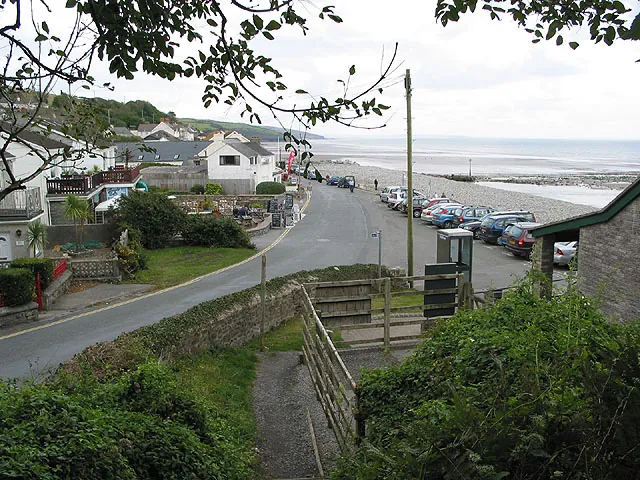
Amroth is a village, parish and community on Carmarthen Bay, within the Pembrokeshire Coast National Park. The beach stretches the whole length of the village, and the village is more or less the road behind the beach. The name is Welsh, and probably means “on (the brook called) Rhath”.
Wikipedia puts Amroth 7 miles (11 km) northeast of Tenby; the straight-line distance from Tenby is 7.0 km. It is the south-to-north start of the Pembrokeshire Coast Path, so the seafront is a beginning or an ending for a fair number of the people standing on it.
Two things pull people out from Tenby. One is the beach, which regularly earns a Blue Flag award. The other is what lies under it: at extreme low tide the remains of a petrified forest, destroyed when sea levels rose 7,000 years ago, can still be seen. Inland and uphill from the seafront is Colby Woodland Garden, which draws more reviews than anything else in the parish.
The sand runs the length of the village, so the beach is easy to reach from wherever you stop. It earned a Blue Flag award in 2020, and the eastern end has had a lifeguard for part of the summer. Public toilets are at either end of the village, and the main car park is managed by the Pembrokeshire Coast National Park Authority.
The drowned forest is the reason to check a tide table rather than simply turn up. It shows only at extreme low tide, which is not every low water, so most visits miss it. The same foreshore has produced fossilised antlers, nuts and animal bones, and Neolithic flints.
Amroth Beach carries 4.8 from 92 Google reviews — a high score, but on a sample small enough that it should not be leaned on. East past Telpyn Point, Telpyn Beach carries 4.6 from 97 Google reviews, and is likewise thinly reviewed.
Four walking routes converge on this one seafront. The Pembrokeshire Coast Path runs west along the coast from its start at Amroth. Since 2012 the trail has also formed part of the Wales Coast Path, which continues eastwards from Amroth over the headland of Telpyn Point towards Pendine. Amroth is the southern terminus of the Knights’ Way, which runs north to St Davids Cathedral, and a section of the Cistercian Way passes through as well.
That is why the village is busier than its size suggests: it is a trailhead as much as a beach.
Colby Woodland Garden, 4.7 from 1,428 Google reviews, is the main draw inland. A visitor in July 2026 described “Lovely woodland gardens with winding paths and bridges over the streams. A mix of manicured lawns and re- wilding,” with a walled garden and a café.
Parking there is the recurring warning. A visitor in July 2026 wrote, “Car park gets very busy. Can park in amroth pay there n walk up to the garden if it’s full.” The same visitor noted the garden is “Dog friendly except walled garden.”
The walk between garden and seafront is a normal part of a day here, and it ends at the pub. The Amroth Arms carries 4.6 from 1,155 Google reviews; a visitor in July 2026 called it a “Great place to walk to from colby woodland. The crab sandwich was beautiful and just what we needed after a long walk.” Another, in August 2026, was honest about the limits of their own visit: “Great place to sit on the beach wall with views across the beach. The food looked great at other tables. We only sampled the drinks.”
The Smugglers, 4.6 from 875 Google reviews, is the other eating place with a substantial review count, and it leans towards families — a visitor in July 2026 mentioned that “the children enjoyed the pirate play area.” Also listed: The Pirate Café at 4.6 from 583 Google reviews, Amroth Castle Coastal Park, a holiday park, at 4.4 from 243, and Green Sheep Camping at 5.0 from 88, a sample too small to weigh.
The parish appears as Amrath on a 1578 parish map of Pembrokeshire, and it was an important anthracite coal mining area until the end of the 19th century. Slight remains of mines and tramways are still visible.
Amroth Castle stands on the north side of the unclassified coast road east of the village, surrounded by a high wall with an entrance archway at the south-western corner. It is not a medieval fortress. The present building is a 19th-century country house built in the style of a mock castle, possibly replacing a small stone castle dating from the 12th century, and the gatehouse is much restored. The ruinous remains of the house are grade I listed.
Its later history is strange. In the 1850s the castle was used as a lunatic asylum. Converted back to a private house in the 1880s, it was later owned and occupied by Owen Colby Philipps, the shipping magnate who bought the White Star Line and was created Baron Kylsant of Carmarthen and Amroth in 1923. It passed to his daughter Nesta, who had married George Coventry, grandson of the 9th Earl of Coventry; they moved out in 1930 when George inherited the Coventry title and estates.
One mile inland is the Anglican parish church of St Elidyr, a grade II* listed building. The community is wider than the seafront suggests, taking in Crunwere, Summerhill, Stepaside, Pleasant Valley, Wisemans Bridge, Llanteg and Llanteglos.
By road, Wikipedia gives the village as 7 miles (11 km) northeast of Tenby. The approach is by an unclassified coast road, which continues east past Amroth Castle. Park in the village car park managed by the National Park Authority; on a hot day the constraint is spaces rather than distance, and the Colby review above suggests some people park in Amroth and walk up to the garden.
On foot, the Pembrokeshire Coast Path runs west along the coast from its start here, and Tenby lies to the south-west, so the trail is a walking route between the two rather than a detour from one.
On public transport, the research pack for Tenby establishes no bus or train service between Tenby and Amroth, and records no station in the village. That is an absence of evidence rather than proof that nothing runs, so check locally before planning to arrive without a car.
The village and what is around it, at walking scale.
Open any of them in Google Maps for directions and current opening.
Attractions, prices and availability in Tenby
These come from GetYourGuide's booking widget, which sets their cookies in your browser. Consent to load it and see the attractions and prices.
Background on Amroth draws on its Wikipedia article, text there being available under CC BY-SA 4.0.