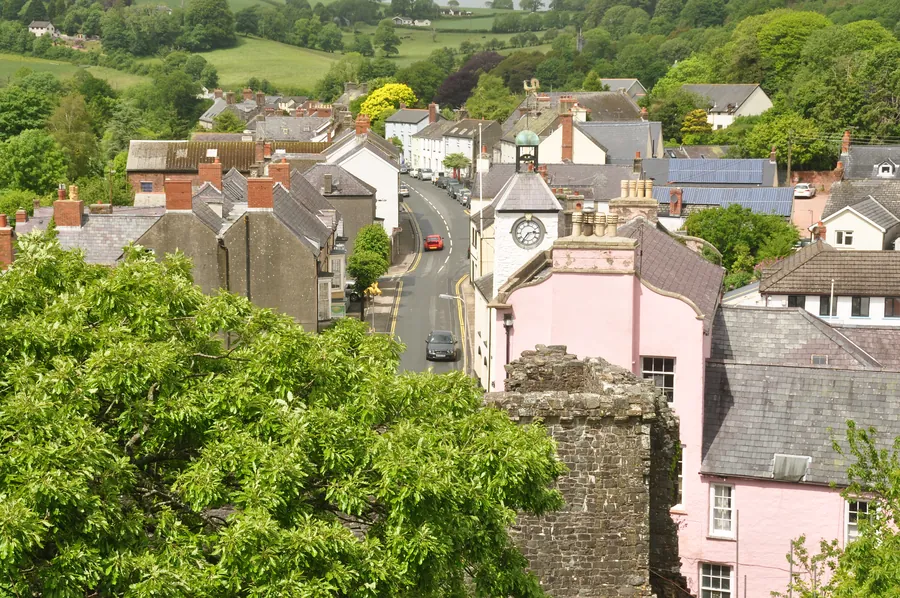
Laugharne (Welsh: Talacharn) is a town of 1,100 people at the 2021 census, on the south coast of Carmarthenshire, on the estuary of the River Taf. It is the trip out of Tenby that crosses the county boundary, and it turns on two things a short walk apart: a castle left an uninhabitable ruin by a Civil War siege, and the house where Dylan Thomas spent the last four years of his life.
The straight-line distance from Tenby is 19.6 km, and Wikipedia gives no road distance. The town sits just on the Landsker Line, in a predominantly English-speaking area, bordered by Llanddowror, St Clears, Llangynog and Llansteffan.
It is small, and those two things are the reason to go rather than a day’s worth of things to do. Thomas, who lived here from 1949 until his death in 1953, described it as a “timeless, mild, beguiling island of a town”, and it is generally accepted as the model for Llareggub in Under Milk Wood; he confirmed twice that the play was based on Laugharne, though topographically it also resembles New Quay.
Laugharne Castle, or Castell Talacharn, carries 4.6 from 2,628 Google reviews, the largest sample of anything here. The Brut y Tywysogyon records Robert Courtemain building a castle here in 1116, the earliest reference to one at or near the town; it was originally known as Abercorran Castle. By 1247 it was held by Guy de Bryan, whose descendants kept it for generations, and in 1575 Elizabeth I granted it to Sir John Perrot, who modernised it as he had Carew. In 1644 it was garrisoned for the king and taken for Parliament by Major-General Rowland Laugharne — it had been a family home — and the siege left it a ruin. Wikipedia dates the standing structure to the 12th century.
Reviewers describe climbing the tower and walking maintained grounds. Two practical details recur. A visitor in June 2026 wrote, “Note there are no toilets on site.” The same visitor warned: “Parking is available at the foot of the castle overlooking the estuary, be sure to pay and display as there is no signage to suggest it is a pay and display car park.”
The Dylan Thomas Boathouse, where he lived with his family from 1949 to 1953, is now a museum and carries 4.5 from 620 Google reviews. You reach it on a footpath, passing his writing shed on the way. The Dylan Thomas Birthday Walk, the setting for Poem in October, is listed at 4.7 from 20 Google reviews — too few to read much into. His grave is in St Martin’s churchyard, marked by a white cross, and rates 4.5 from 217.
Reviewers divide on whether the literary trail delivers. A visitor in August 2026 was unconvinced: “First time visit not what I was inspecting they’re just using Dylan Thomas name to attract visitors but a lovely walk down the footpath”. A visitor in June 2026 took the opposite view, calling it “A small home with a big history and insight into the genius of Dylan Thomas”.
The grave needs managing expectations. A visitor in July 2026 described it as “Just a simple wooden cross on a bare mound of earth, no headstone”. The link between the sites is not flat: a visitor in April 2026 called it “A heavy walk from the boathouse but interesting”, and added, “Sadly the church was locked so couldn’t see inside”. The church is not reliably open.
Thomas is not the only writer attached to the town. Richard Hughes, at Castle House, was instrumental in his moving here, and Kingsley Amis wrote the Booker Prize-winning The Old Devils at Cliff House. The Laugharne Weekend, a three-day arts festival first held in spring 2007, uses the Millennium Hall as its main venue with smaller events at the Boathouse; headliners have included Ray Davies, Will Self and Patti Smith.
Laugharne Corporation is a rare surviving medieval corporation in the United Kingdom, established in 1291 by Sir Guy de Brian. It is presided over by the portreeve, who wears a chain of gold cockle shells with one added by each holder of the office, his name and date of tenure on the reverse. The title is conferred annually, at the Big Court on the first Monday after Michaelmas, and the corporation still holds a court leet half-yearly and a court baron every fortnight for civil suits within the lordship. The most senior 76 burgesses each get a strang of land on Hugden for life, farmed in medieval strips; the Laugharne open-field system is one of only two surviving and still in use in Britain.
That continuity shows in the fabric. The township has 69 listed buildings, including the Georgian townhouses The Great House and Castle House and Island House, parts of which date to the Tudor period — all three grade II* listed. St Martin’s parish church was built in the 14th century by Guido de Brian, lord of the manor, and holds a cross-slab probably of the 9th or 10th century carved with a Celtic design that has been suggested to be Viking in origin.
The deepest history is not in the town but on Coygan Bluff, a limestone peninsula overlooking a now-submerged coastal plain to the south. A cave there, excavated five times between 1865 and 1965, yielded evidence of hunter-gatherers sheltering over 50,000 years ago and flint tools from the Mesolithic and Neolithic — which is why the township is described as probably the oldest still-inhabited settlement in Wales. A hoard of over 2,000 coins and the remains of a Roman bath were found at Island House.
This is a car trip. The transport notes for the Tenby area establish no bus or train between Tenby and Laugharne, and Wikipedia’s article records no station or service, so nothing here supports a public route — check locally rather than assuming one exists. Reviewers consistently describe arriving by road and using the car park at the foot of the castle, which is pay and display without signage saying so.
Because the town is a couple of hours rather than a day, it pairs with something else on the same road out. It shares an electoral ward with Pendine and Llanddowror, and Pendine is nearer Tenby at 12.6 km straight-line. A visitor in June 2026 who stopped only briefly at the castle planned a second trip for the Thomas heritage walk: the castle and estuary on one visit, the boathouse, walk and grave on another.
The village and what is around it, at walking scale.
Open any of them in Google Maps for directions and current opening.
Attractions, prices and availability in Tenby
These come from GetYourGuide's booking widget, which sets their cookies in your browser. Consent to load it and see the attractions and prices.
Background on Laugharne draws on its Wikipedia article, text there being available under CC BY-SA 4.0.