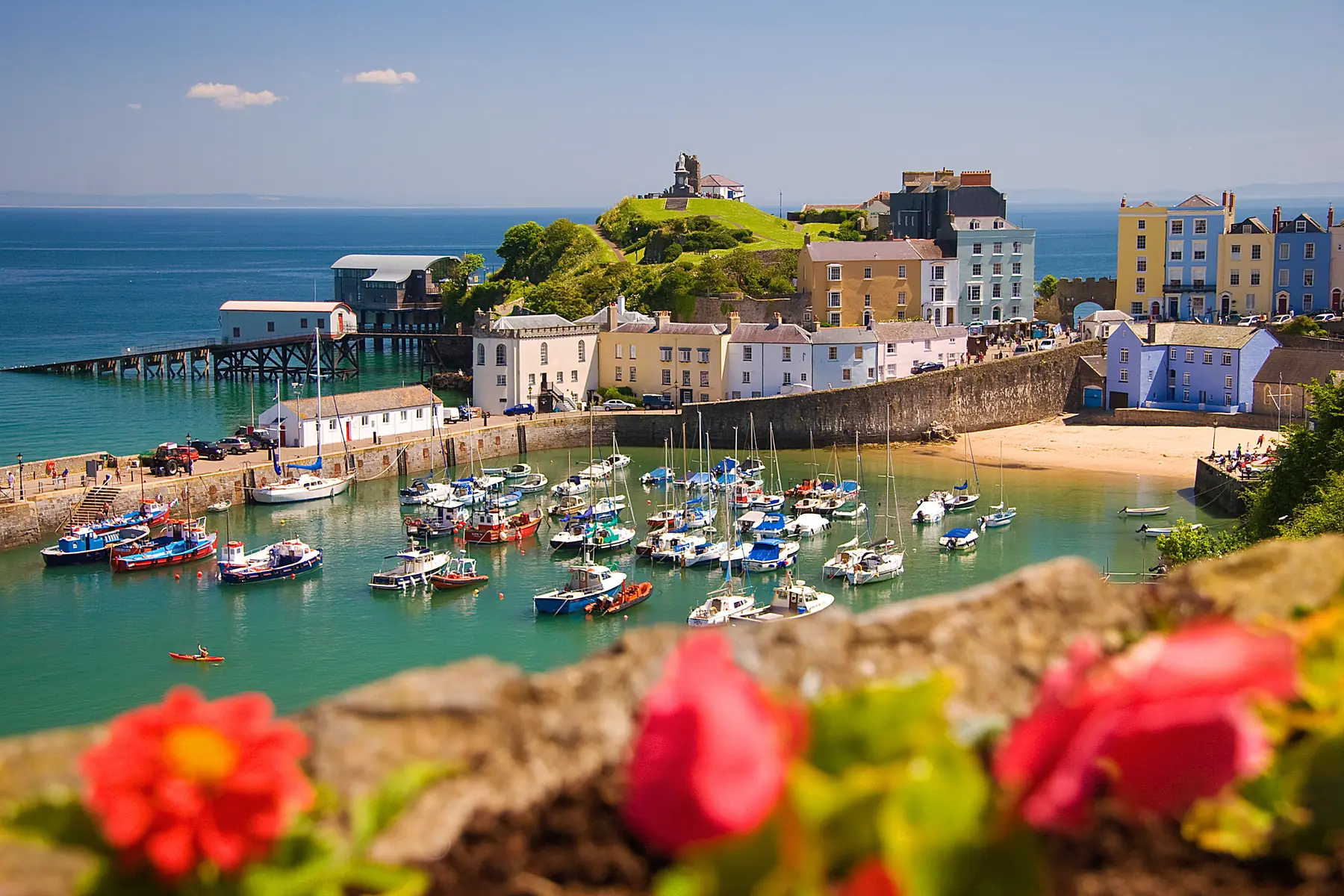
Tenby faces east across Carmarthen Bay, which makes it drier and more sheltered than the Atlantic-facing side of Pembrokeshire — but this is west Wales, and any week here should assume rain.
The town handles it better than most small resorts because the medieval street plan works in its favour: narrow lanes, overhanging buildings, a covered market and a great many small shops, pubs and cafés packed into a few hundred metres. And within ten kilometres there are two large indoor family attractions and three castles.
Eight kilometres north, and the reason a wet week in south Pembrokeshire is manageable. Its vintage indoor funfair is a covered hall of restored fairground rides — carousels, waltzers, dodgems — with unlimited rides included in the ticket, and it is backed by indoor play barns and the zoo’s animal houses.
Expect it to be busy when the weather turns, because everyone in the county has the same idea.
Four kilometres out. An activity park with a substantial indoor element — bowling, laser tag, indoor karting and soft play — paid per activity. It suits older children.
On Castle Hill, and one of the oldest independent museums in Wales, founded in 1878. It covers the town’s history, archaeology, geology and maritime past, with an art gallery holding work by Augustus and Gwen John, who were born here. Small, cheap and genuinely good. An hour and a half.
On Quay Hill, National Trust. A late fifteenth-century merchant’s house furnished as it would have been around 1500, over three floors, with the original fireplaces and a small herb garden behind. It takes half an hour and it is the best surviving domestic building of its period in Wales.
Free and open. The largest parish church in Wales, with a fifteenth-century wagon roof and the tomb of Thomas White, the mayor who hid the future Henry VII in his cellar in 1471 before shipping him to France.
Cars are excluded from the centre in summer and the lanes are narrow, which means you can move between the shops, galleries, bookshops, pubs and cafés of High Street, Tudor Square, St Julian’s Street and Frog Street without getting properly wet. Tenby has an unusually good independent retail scene for its size.
Harbwr Brewery on St Julian’s Street has a taproom and kitchen serving through the day.
Pembroke Castle, fifteen kilometres west, has the great round keep with its stone dome, the gatehouse, wall passages and the Wogan Cavern, a large natural cave beneath the castle — between them a substantial amount of shelter, plus an exhibition.
Carew Castle, nine kilometres north-west, has the Elizabethan ranges and, better, the restored tidal mill, which is entirely under cover and one of only four working tidal mills in Britain.
Manorbier, seven kilometres south-west, is compact with covered sections.
Lamphey Bishop’s Palace and Picton Castle, further out, add a ruined palace and a lived-in house with guided interior tours and a woodland garden.
Manor Wildlife Park at St Florence works in rain — the animals are outdoors anyway and there are indoor houses.
Folly Farm’s zoo section, likewise.
Carmarthen, forty-five kilometres east, has covered shopping, a museum and the National Botanic Garden of Wales with its enormous single-span glasshouse half an hour further on — which is the definitive south Wales wet-day destination.
Swansea, eighty kilometres east, has the National Waterfront Museum, the Dylan Thomas Centre and the Glynn Vivian gallery.
Laugharne, twenty kilometres east, has Dylan Thomas’s Boathouse and writing shed above the estuary, and the castle. Small, atmospheric and better in weather.
Colby Woodland Garden at Amroth is a National Trust valley garden under trees — sheltered, and at its best in the wet.
The Carew millpond circuit is level and short.
Tenby’s own beaches in a storm are worth seeing: South Beach with the sea running and the town on its headland behind is a considerable sight, and the walk takes twenty minutes.
Avoid the exposed cliff sections towards Lydstep in a gale, and remember that the Penally range closes the coast path south of the town when firing.
Trains run from Tenby to Carmarthen and Swansea in one direction and Pembroke Dock in the other, which makes a wet-day escape possible without a car.
Parking is on the edge of town, since cars are banned from the centre in summer.
Seasonal closing. A substantial number of Pembrokeshire attractions and the Caldey boats close from November to March. Check before travelling out of season.
Boats. The Caldey Island service and the sea trips stop in wind and swell, which is more often than in rain.
The shape that works: Tenby Museum on Castle Hill first thing, which is an hour and a half and has the best view in town from the window. The Tudor Merchant’s House on Quay Hill next, which is half an hour. Lunch in one of the old town pubs. Then the drive out to Pembroke Castle for the afternoon — the keep, the gatehouse and the cavern are substantial shelter — or Folly Farm’s funfair if there are children.
Finish with the walled town, which is genuinely pleasant in the rain because the lanes are narrow and the shops are small.
Tenby faces east into Carmarthen Bay, sheltered from the prevailing south-westerlies by the whole of the Pembrokeshire peninsula. That makes it noticeably calmer and sunnier than the Atlantic-facing coast around St Davids and Newgale on the same day.
It also means the sea here is warmer and flatter, which is why the town became a bathing resort in the first place. If the forecast is westerly and rough, Tenby is frequently the best place in Pembrokeshire to be.
Tenby’s medieval street plan is its wet-weather asset. The lanes inside the walls are narrow, the buildings overhang, and Tudor Square, High Street, St Julian’s Street and Upper Frog Street carry a dense run of independent shops, galleries, bookshops, cafés and pubs within a few hundred metres.
Because cars are excluded from the centre in summer, walking between them is genuinely pleasant rather than a scramble along a kerb.
The Harbwr Brewery taproom on St Julian’s Street serves food through the day, and the town’s older pubs are small, low-ceilinged and entirely comfortable with wet visitors.
Folly Farm’s indoor funfair, Tenby Museum, the Tudor Merchant’s House, and Pembroke or Carew castles within fifteen kilometres.
Yes — one of the oldest independent museums in Wales, with an art gallery holding work by Augustus and Gwen John, who were born in the town.
Folly Farm, for the covered vintage funfair and the indoor play barns.
In light rain, usually. They stop in wind and swell, and they do not run on Sundays or outside the Easter-to-October season.
Carmarthen and the National Botanic Garden of Wales, or Swansea, both east along the train line.